Tampilkan postingan dengan label sguil. Tampilkan semua postingan

Minggu, 24 Februari 2013

Recovering from Suricata Gone Wild

Recently I tried interacting with one of my lab Security Onion sensors running the Suricata IDS. I found the Sguil server was taking a really long time to offer services on port 7734 TCP. Since I hadn't worked with this lab system in a while, I guessed that there might be too many uncategorized events in the Sguil database. I dusted off an old blog post titled More Snort and Sguil Tuning from 2006 and took a look at the system.

First I stopped the NSM applications on the server.


sudo service nsm stop
Stopping: securityonion
* stopping: sguil server [ OK ]
Stopping: HIDS
* stopping: ossec_agent (sguil) [ OK ]
Stopping: Bro
stopping ds61so-eth1-1 ...
stopping proxy ...
stopping manager ...
Stopping: ds61so-eth1
* stopping: netsniff-ng (full packet data) [ OK ]
* stopping: pcap_agent (sguil) [ OK ]
* stopping: snort_agent (sguil) [ OK ]
* stopping: suricata (alert data) [ OK ]
* stopping: barnyard2 (spooler, unified2 format) [ OK ]
* stopping: prads (sessions/assets) [ OK ]
* stopping: sancp_agent (sguil) [ OK ]
* stopping: pads_agent (sguil) [ OK ]
* stopping: argus [ OK ]
* stopping: http_agent (sguil)
Next I ran a query to look for the top uncategorized events.

$ mysql -uroot
Welcome to the MySQL monitor. Commands end with ; or \g.
Your MySQL connection id is 1639
Server version: 5.5.29-0ubuntu0.12.04.1 (Ubuntu)

Copyright (c) 2000, 2012, Oracle and/or its affiliates. All rights reserved.

Oracle is a registered trademark of Oracle Corporation and/or its
affiliates. Other names may be trademarks of their respective
owners.

Type 'help;' or '\h' for help. Type '\c' to clear the current input statement.

mysql> use securityonion_db;
Reading table information for completion of table and column names
You can turn off this feature to get a quicker startup with -A

Database changed

mysql> SELECT COUNT(signature)as count, signature FROM event WHERE status=0 GROUP BY signature ORDER BY count DESC LIMIT 20;
+---------+----------------------------------------------------------------------------------+
| count | signature |
+---------+----------------------------------------------------------------------------------+
| 2299160 | SURICATA STREAM Packet with invalid ack |
| 2298505 | SURICATA STREAM ESTABLISHED invalid ack |
| 1777530 | SURICATA STREAM ESTABLISHED packet out of window |
| 38700 | SURICATA STREAM ESTABLISHED retransmission packet before last ack |
| 24181 | SURICATA STREAM TIMEWAIT ACK with wrong seq |
| 5430 | ET POLICY GNU/Linux APT User-Agent Outbound likely related to package management |
| 3160 | SURICATA STREAM Last ACK with wrong seq |
| 753 | ET POLICY Dropbox.com Offsite File Backup in Use |
| 637 | SURICATA HTTP unknown error |
| 626 | SURICATA STREAM SHUTDOWN RST invalid ack |
| 505 | SURICATA STREAM FIN1 FIN with wrong seq |
| 494 | SURICATA HTTP request field too long |
| 448 | ET POLICY PE EXE or DLL Windows file download |
| 315 | ET RBN Known Malvertiser IP (22) |
| 270 | ET POLICY iTunes User Agent |
| 266 | SURICATA STREAM CLOSEWAIT ACK out of window |
| 237 | ET INFO EXE IsDebuggerPresent (Used in Malware Anti-Debugging) |
| 219 | ET POLICY MOBILE Apple device leaking UDID from SpringBoard |
| 217 | SURICATA STREAM 3way handshake with ack in wrong dir |
| 151 | SURICATA STREAM FIN2 FIN with wrong seq |
+---------+----------------------------------------------------------------------------------+
20 rows in set (15.24 sec)
Wow, that's a lot of SURICATA STREAM events. I need to categorize them as non-issues to recover the Sguil server.


mysql> UPDATE event SET status=1, last_modified='2013-02-24 16:26:00', last_uid='sguil' WHERE event.status=0 and event.signature LIKE 'SURICATA STREAM%';
Query OK, 6443375 rows affected, 65535 warnings (3 min 4.89 sec)
Rows matched: 6443375 Changed: 6443375 Warnings: 6443375
Let's see what the database thinks now.

mysql> SELECT COUNT(signature)as count, signature FROM event WHERE status=0 GROUP BY signature ORDER BY count DESC LIMIT 20;
+------+-----------------------------------------------------------------------------------------+
| cnt | signature |
+------+-----------------------------------------------------------------------------------------+
| 5430 | ET POLICY GNU/Linux APT User-Agent Outbound likely related to package management |
| 753 | ET POLICY Dropbox.com Offsite File Backup in Use |
| 637 | SURICATA HTTP unknown error |
| 494 | SURICATA HTTP request field too long |
| 448 | ET POLICY PE EXE or DLL Windows file download |
| 315 | ET RBN Known Malvertiser IP (22) |
| 270 | ET POLICY iTunes User Agent |
| 237 | ET INFO EXE IsDebuggerPresent (Used in Malware Anti-Debugging) |
| 219 | ET POLICY MOBILE Apple device leaking UDID from SpringBoard |
| 133 | ET INFO PDF Using CCITTFax Filter |
| 106 | ET POLICY Pandora Usage |
| 97 | ET CHAT Facebook Chat (buddy list) |
| 93 | ET POLICY MOBILE Apple device leaking UDID from SpringBoard via GET |
| 58 | ET POLICY Internal Host Retrieving External IP via whatismyip.com - Possible Infection |
| 41 | PADS New Asset - ssl TLS 1.0 Client Hello |
| 39 | SURICATA HTTP response header invalid |
| 39 | ET CURRENT_EVENTS Exploit Kit Delivering Compressed Flash Content to Client |
| 36 | ET POLICY Python-urllib/ Suspicious User Agent |
| 36 | ET MALWARE Possible Windows executable sent when remote host claims to send a Text File |
| 28 | ET POLICY Http Client Body contains pw= in cleartext |
+------+-----------------------------------------------------------------------------------------+
20 rows in set (0.03 sec)
That's much better.

Before restarting the NSM services, I edit the autocat.conf file to add the following.


none||ANY||ANY||ANY||ANY||ANY||ANY||%%REGEXP%%^SURICATA STREAM||1
This will auto-categorize any SURICATA STREAM alerts as non-issues. I want to keep adding events to the database for testing purposes, but I don't want to see them in the console.

Now I restart the NSM services.


sudo service nsm start
Starting: securityonion
* starting: sguil server [ OK ]
Starting: HIDS
* starting: ossec_agent (sguil) [ OK ]
Starting: Bro
starting manager ...
starting proxy ...
starting ds61so-eth1-1 ...
Starting: ds61so-eth1
* starting: netsniff-ng (full packet data) [ OK ]
* starting: pcap_agent (sguil) [ OK ]
* starting: snort_agent (sguil) [ OK ]
* starting: suricata (alert data) [ OK ]
* starting: barnyard2 (spooler, unified2 format) [ OK ]
* starting: prads (sessions/assets) [ OK ]
* starting: pads_agent (sguil) [ OK ]
* starting: sancp_agent (sguil) [ OK ]
* starting: argus [ OK ]
* starting: http_agent (sguil) [ OK ]
* disk space currently at 22%
I check to see if port 7734 TCP is listening.

sudo netstat -natup | grep 7734
tcp 0 0 0.0.0.0:7734 0.0.0.0:* LISTEN 10729/tclsh

Now the Sguil server is listening. I can connect with a Sguil client, even the 64 bit Windows .exe that I just found this morning. Check it out at sourceforge.net/projects/sguil/

Selasa, 09 November 2010

Two New Tools in Snort

No sooner do I get Snort 2.9.0.1 running than something breaks. However, thanks to Niels Horn I know a little more about two new tools included with Snort.

First is u2spewfoo, which reads Unified2 output files and outputs them as text.

[sguil@r200a /nsm/r200a]$ u2spewfoo snort.unified2.1289360307 | head -20

(Event)
sensor id: 0 event id: 1 event second: 1289360859 event microsecond: 881345
sig id: 2011032 gen id: 1 revision: 4 classification: 3
priority: 2 ip source: 192.168.2.107 ip destination: 172.16.2.1
src port: 44597 dest port: 3128 protocol: 6 impact_flag: 0 blocked: 0

Packet
sensor id: 0 event id: 1 event second: 1289360859
packet second: 1289360859 packet microsecond: 881345
linktype: 1 packet_length: 1168
00 15 17 0B | 7D 4C 00 13 | 10 65 2F AC | 08 00 45 00
04 82 C2 E3 | 40 00 3F 06 | 03 6E C0 A8 | 02 6B AC 10
02 01 AE 35 | 0C 38 73 6F | 02 7F 12 37 | D9 A8 80 18
03 EA 6D 85 | 00 00 01 01 | 08 0A 01 2A | 34 44 75 11
33 8C 41 46 | 69 72 73 74 | 25 32 43 25 | 32 30 49 25
32 30 74 65 | 73 74 65 64 | 25 32 30 6D | 79 25 32 30
6F 6C 64 25 | 32 30 73 63 | 72 69 70 74 | 73 25 32 30
6F 6E 25 32 | 30 46 72 65 | 65 42 53 44 | 25 32 30 37
2E 78 25 32 | 43 25 32 30 | 61 6E 64 25 | 32 30 6E 6F

I guess that's good for troubleshooting. It feels a little like 1999!

The second tool is u2boat, which transforms the pcap data in a Unified2 output file into a normal pcap file.

[sguil@r200a /nsm/r200a]$ u2boat snort.unified2.1289360307
Usage: u2boat [-t type]
[sguil@r200a /nsm/r200a]$ u2boat snort.unified2.1289360307 snort.unified2.1289360307.pcap
Defaulting to pcap output.
[sguil@r200a /nsm/r200a]$ file snort.unified2.1289360307.pcap
snort.unified2.1289360307.pcap: tcpdump capture file (little-endian)
- version 2.4 (Ethernet, capture length 65535)
[sguil@r200a /nsm/r200a]$ tcpdump -n -r snort.unified2.1289360307.pcap
reading from file snort.unified2.1289360307.pcap, link-type EN10MB (Ethernet)
22:47:39.881345 IP 192.168.2.107.44597 > 172.16.2.1.3128: Flags [P.],
ack 305650088, win 1002, options [nop,nop,TS val 19543108 ecr 1964061580], length 1102

So those are great, but fortunately unless I fix Barnyard2 or a fix is committed, Barnyard2 is going to die when it encounters record types from Snort that Barnyard2 doesn't recognize, e.g.:

r200a# barnyard2 -U -d /nsm/r200a -f snort.unified2 -c /usr/local/etc/nsm/barnyard2.conf
Running in Continuous mode

--== Initializing Barnyard2 ==--
Initializing Input Plugins!
Initializing Output Plugins!
Parsing config file "/usr/local/etc/nsm/barnyard2.conf"
Log directory = /var/log/barnyard2
sguil: sensor name = r200a
sguil: agent port = 7735
sguil: Connected to localhost on 7735.

--== Initialization Complete ==--

______ -*> Barnyard2 <*-
/ ,,_ \ Version 2.1.8 (Build 251)
|o" )~| By the SecurixLive.com Team: http://www.securixlive.com/about.php
+ '''' + (C) Copyright 2008-2010 SecurixLive.

Snort by Martin Roesch & The Snort Team: http://www.snort.org/team.html
(C) Copyright 1998-2007 Sourcefire Inc., et al.

Using waldo file '/nsm/r200a/waldo':
spool directory = /nsm/r200a
spool filebase = snort.unified2
time_stamp = 1289360307
record_idx = 4
Opened spool file '/nsm/r200a/snort.unified2.1289360307'
ERROR: Unknown record type read: 110
Fatal Error, Quitting..

The good news is the alerts will continue to be logged to disk, and can be processed once Barnyard2 can read them.

Using Git with FreeBSD Sguil Scripts

Before today I never committed anything using Git. Previously I used CVS, but never got around to trying something more modern like SVN. However, I know several developers at work use Git, so I figured I would try committing my FreeBSD Sguil scripts (lame as they are) to Git at Sourceforge. This would allow me to keep track of changes and get the code out of my own repository for sharing and safekeeping.

I started by cleaning up the directory where I kept the scripts.

After following the instructions to enable Git, I took these actions.


richard@macmini:~/taosecurity_freebsd_sguil$ git init
Initialized empty Git repository in /home/richard/taosecurity_freebsd_sguil/.git/

richard@macmini:~/taosecurity_freebsd_sguil$ git config user.name "Richard Bejtlich"

richard@macmini:~/taosecurity_freebsd_sguil$ git config user.email \
"taosecurity@users.sourceforge.net"

richard@macmini:~/taosecurity_freebsd_sguil$ git remote add origin \
ssh://taosecurity@taosecurity.git.sourceforge.net/gitroot/taosecurity/taosecurity

richard@macmini:~/taosecurity_freebsd_sguil$ git config branch.master.remote origin

richard@macmini:~/taosecurity_freebsd_sguil$ git config branch.master.merge refs/head/master

richard@macmini:~/taosecurity_freebsd_sguil$ git push origin master

taosecurity@taosecurity.git.sourceforge.net's password:
error: src refspec master does not match any.
fatal: The remote end hung up unexpectedly
error: failed to push some refs to 'ssh://taosecurity@taosecurity.git.sourceforge.net/gitroot \
/taosecurity/taosecurity'

That was unfortunate. I didn't see that error in the Sourceforge guide, but after checking here I found that trying to add all the files might be the right step.


richard@macmini:~/taosecurity_freebsd_sguil$ git add *

richard@macmini:~/taosecurity_freebsd_sguil$ git commit -am "Message"

Created initial commit bd18669: Message
28 files changed, 1400 insertions(+), 0 deletions(-)
create mode 100755 README
create mode 100644 SguildLoaderd.tcl.patch
create mode 100644 SguildMysqlMerge.tcl.patch
create mode 100755 barnyard2
create mode 100644 barnyard2.conf
create mode 100644 barnyard2.conf.patch
create mode 100644 log_packets.sh.crontab
create mode 100644 log_packets.sh.patch
create mode 100644 pcap_agent.conf.patch
create mode 100755 prep_platform.sh
create mode 100644 rc-adds.txt
create mode 100755 rc-conf.sh
create mode 100755 sancp
create mode 100644 sancp.conf.patch
create mode 100644 sancp_agent.conf.patch
create mode 100644 sensor_agent.conf.patch
create mode 100755 sguil_database_install_pt1.sh
create mode 100755 sguil_database_install_pt2.sh
create mode 100755 sguil_sensor_install.sh
create mode 100755 sguil_sensor_install_patch.sh
create mode 100644 sguil_sensor_users.txt
create mode 100755 sguil_server_install.sh
create mode 100644 sguild.conf.patch
create mode 100755 sguild_adduser.sh
create mode 100755 snort
create mode 100644 snort.conf.patch
create mode 100644 snort_agent.conf.patch
create mode 100755 snort_src_install.sh

richard@macmini:~/taosecurity_freebsd_sguil$ git push origin master
taosecurity@taosecurity.git.sourceforge.net's password:

Counting objects: 30, done.
Compressing objects: 100% (29/29), done.
Writing objects: 100% (30/30), 17.31 KiB, done.
Total 30 (delta 4), reused 0 (delta 0)
To ssh://taosecurity@taosecurity.git.sourceforge.net/gitroot/taosecurity/taosecurity
* [new branch] master -> master

That did it. I found that if I didn't make a change but tried to note one, nothing happened (as expected).


richard@macmini:~/taosecurity_freebsd_sguil$ git commit -am "Commit scripts using Git"
# On branch master
nothing to commit (working directory clean)

richard@macmini:~/taosecurity_freebsd_sguil$ git push origin
mastertaosecurity@taosecurity.git.sourceforge.net's password:
Everything up-to-date

Next I made some fixes and committed those.

richard@macmini:~/taosecurity_freebsd_sguil$ vi README
richard@macmini:~/taosecurity_freebsd_sguil$ git commit -am "Modify README to reflect changing ExtNet."
Created commit 2ef21f3: Modify README to reflect changing ExtNet.
1 files changed, 3 insertions(+), 1 deletions(-)

richard@macmini:~/taosecurity_freebsd_sguil$ git push origin mastertaosecurity@taosecurity.git.sourceforge.net's password:
Counting objects: 5, done.
Compressing objects: 100% (3/3), done.
Writing objects: 100% (3/3), 413 bytes, done.
Total 3 (delta 2), reused 0 (delta 0)
To ssh://taosecurity@taosecurity.git.sourceforge.net/gitroot/taosecurity/taosecurity
bd18669..2ef21f3 master -> master

Checking out files is pretty easy, assuming Git is installed.

richard@neely:~$ mkdir gittest

richard@neely:~$ cd gittest

richard@neely:~/gittest$ git clone git://taosecurity.git.sourceforge.net/gitroot/taosecurity/taosecurity

Initialized empty Git repository in /home/richard/gittest/taosecurity/.git/
remote: Counting objects: 30, done.
remote: Compressing objects: 100% (29/29), done.
remote: Total 30 (delta 4), reused 0 (delta 0)
Receiving objects: 100% (30/30), 17.25 KiB, done.
Resolving deltas: 100% (4/4), done.

richard@neely:~/gittest$ cd taosecurity

richard@neely:~/gittest/taosecurity$ ls

barnyard2 sguild_adduser.sh
barnyard2.conf sguil_database_install_pt1.sh
barnyard2.conf.patch sguil_database_install_pt2.sh
log_packets.sh.crontab sguild.conf.patch
log_packets.sh.patch SguildLoaderd.tcl.patch
pcap_agent.conf.patch SguildMysqlMerge.tcl.patch
prep_platform.sh sguil_sensor_install_patch.sh
rc-adds.txt sguil_sensor_install.sh
rc-conf.sh sguil_sensor_users.txt
README sguil_server_install.sh
sancp snort
sancp_agent.conf.patch snort_agent.conf.patch
sancp.conf.patch snort.conf.patch
sensor_agent.conf.patch snort_src_install.sh

So, now my scripts are available for me to add changes and for anyone who might be interested to retrieve them.

Updates to Sguil on FreeBSD Scripts

Early last year I posted Notes on Installing Sguil Using FreeBSD 7.1 Packages where I examined using the various FreeBSD ports for Sguil. In that post I showed that a lot of work was required to deploy Sguil, even if you used the ports or packages. Previously I've written about a set of scripts I maintain for deploying Sguil platforms in my lab. I decided to take a look at those scripts and update them for a modern environment, since a lot has happened in the almost two years since I last used the scripts.

First, I tested my old scripts on FreeBSD 7.x, and now 8.x is common. Second, Snort 2.9.0.1 is available, and with it the new DAQ mechanism for accessing network traffic. Third, Barnyard has been deprecated in favor of Barnyard2, thanks to the guys at the NSMNow project. There have been a lot of changes with rules and other areas. I also wanted to try running a 64 bit environment on a Dell R200 as my primary lab sensor. Finally, I decided to switch from using CVS at Sourceforge to Git at Sourceforge. I'll explain that in a separate post.

The end result of my work is available now at http://taosecurity.git.sourceforge.net. Please remember that these scripts are basically a way for me to document how I installed certain versions of various NSM applications on a specific FreeBSD platform. There's no error checking, and no support available. Basically, if you want to see how I deploy all of the non-client parts of Sguil on FreeBSD 8.1, feel free to check out the scripts.

One aspect of this that might be helpful is that by reading the scripts you can follow how to go from a basic FreeBSD installation to a completely functioning, all-in-one (minus the client) Sguil platform.

Jumat, 22 Januari 2010

Sguil 0.7.0 on Ubuntu 9.10

Today I installed a Sguil client on a fresh installation of Ubuntu 9.10.

It was really easy with the exception of one issue I had to troubleshoot, explained below.

First notice that tcl8.4 and tk8.4 is already installed on Ubuntu 9.10.

richard@janney:~$ dpkg --list | grep -i tcl
ii tcl8.4 8.4.19-3
Tcl (the Tool Command Language) v8.4 - run-t
ii tk8.4 8.4.19-3
Tk toolkit for Tcl and X11, v8.4 - run-time
richard@janney:~$ sudo apt-get install tclx8.4 tcllib
iwidgets4 tcl-tlsReading package lists... Done
Building dependency tree
Reading state information... Done
The following extra packages will be installed:
itcl3 itk3
Suggested packages:
itcl3-doc itk3-doc iwidgets4-doc tclx8.4-doc
The following NEW packages will be installed:
itcl3 itk3 iwidgets4 tcl-tls tcllib tclx8.4
0 upgraded, 6 newly installed, 0 to remove and 0 not upgraded.
Need to get 4,127kB of archives.
After this operation, 18.1MB of additional disk space will be used.
Do you want to continue [Y/n]? y
Get:1 http://us.archive.ubuntu.com karmic/universe itcl3 3.2.1-5 [99.4kB]
...truncated...

Next install wireshark via apt-get. I don't show that here.

The server I want to connect to is running Sguil 0.7.0, not the version currently in CVS. If you try connecting from a CVS client to a 0.7.0 server, the client will report an error like

error writing "sock6": connection reset by peer

On the server side you will see Sguil die on error:

pid(37598) Client Connect: 192.168.2.194 39901 sock15
pid(37598) Validating client access: 192.168.2.194
pid(37598) Valid client access: 192.168.2.194
pid(37598) Sending sock15: SGUIL-0.7.0 OPENSSL ENABLED
pid(37598) Client Command Received: VersionInfo {SGUIL-0.7.0 OPENSSL ENABLED}
pid(37598) ERROR: Client connect denied - mismatched versions
pid(37598) CLIENT VERSION: {SGUIL-0.7.0 OPENSSL ENABLED}
pid(37598) SERVER VERSION: SGUIL-0.7.0 OPENSSL ENABLED
Error: can not find channel named "sock15"
can not find channel named "sock15"
while executing
"close $socketID"
(procedure "ClientVersionCheck" line 11)
invoked from within
"ClientVersionCheck $socketID $data1 "
("VersionInfo" arm line 1)
invoked from within
"switch -exact $clientCmd {
DeleteEventID { $clientCmd $socketID $index1 $index2 }
DeleteEventIDList { $clientCmd $socketID $data1 }
..."
(procedure "ClientCmdRcvd" line 38)
invoked from within
"ClientCmdRcvd sock15"
SGUILD: killing child procs...
SGUILD: Exiting...

If you diff the sguil.tk from 0.7.0 against sguil.tk from CVS these differences explain what is happening:

richard@janney:~/sguil/client$ diff /home/richard/Downloads/sguil-0.7.0/client/sguil.tk sguil.tk
5c5
< # $Id: sguil.tk,v 1.249 2008/03/25 15:59:34 bamm Exp $ #
---
> # $Id: sguil.tk,v 1.254 2008/09/21 02:59:25 bamm Exp $ #
156,162d155
< # store $data in $origData because ctoken changes the var it is working on.
< #set origData $data
< #set serverCmd [ctoken data " "]
< #set data1 [string trimleft $data]
< # data1 has indices 1 on etc etc
< #set index1 [ctoken data " "]
< #set data2 [string trimleft $data]
203a197
> PassChange { $serverCmd [lindex $data 1] [lindex $data 2] }
235c229
< puts $socketID "VersionInfo $tmpVERSION"
---
> puts $socketID [list VersionInfo $tmpVERSION]
...truncated...

Finally I like to edit my sguil.conf as shown to account for Wireshark's location and to reduce the number of panes from the default of 3 down to 1.

richard@janney:~/Downloads/sguil-0.7.0/client$ diff sguil.conf.orig sguil.conf
49c49
< set WIRESHARK_PATH /usr/sbin/wireshark
---
> set WIRESHARK_PATH /usr/bin/wireshark
73c73
< set RTPANES 3
---
> set RTPANES 1
78,80c78,80
< set RTPANE_PRIORITY(0) "1"
< set RTPANE_PRIORITY(1) "2 3"
< set RTPANE_PRIORITY(2) "4 5"
---
> set RTPANE_PRIORITY(0) "1 2 3 4 5"
> #set RTPANE_PRIORITY(1) "2 3"
> #set RTPANE_PRIORITY(2) "4 5"

At this point I can use the Sguil client.

Unfortunately I continue to have a problem with DNS resolution. (I reported one a while back.)

can't read "state(reply)": no such element in array
while executing
"binary scan $state(reply) SSSSSS mid hdr nQD nAN nNS nAR"
(procedure "Flags" line 13)
invoked from within
"Flags $token flags"
(procedure "dns::name" line 3)
invoked from within
"dns::name $tok"
(procedure "GetHostbyAddr" line 47)
invoked from within
"GetHostbyAddr $srcIP"
(procedure "ResolveHosts" line 23)
invoked from within
"ResolveHosts"
invoked from within
".eventPane.pane1.childsite.detailPane.pane0.childsite.detailTabs.canvas.notebook.
cs.page1.cs.ipDataFrame.dnsDataFrame.dnsActionFrame.dnsButton invoke"
("uplevel" body line 1)
invoked from within
"uplevel #0 [list $w $cmd]"
(procedure "tk::CheckRadioInvoke" line 3)
invoked from within
"tk::CheckRadioInvoke .eventPane.pane1.childsite.detailPane.pane0.childsite.detailTabs.canvas.notebook.
cs.page1.cs.ipDataFrame.dnsDataFrame.dnsActionFr..."
(command bound to event)

I noticed a similar error on the sguil-users mailing list and tried installing libudp-tcl, but I got the same error.

Rabu, 30 Desember 2009

Difference Between Bejtlich Class and SANS Class

A comment on my last post, Reminder: Bejtlich Teaching at Black Hat DC 2010, a reader asked:

I am trying to get my company sponsorship for your class at Black Hat. However, I was ask to justify between your class and SANS 503, Intrusion Detection In-Depth.

Would you be able to provide some advice?


That's a good question, but it's easy enough to answer. The overall point to keep in mind is that TCP/IP Weapons School 2.0 is a new class, and when I create a new class I design it to be different from everything that's currently on the market. It doesn't make sense to me to teach the same topics, or use the same teaching techniques, found in classes already being offered. Therefore, when I first taught TWS2 at Black Hat DC last year, I made sure it was unlike anything provided by SANS or other trainers.

Beyond being unique, here are some specific points to consider. I'm sure I'll get some howls of protest from the SANS folks, but they have their own platform to justify their approach. The two classes are very different, each with a unique focus. It's up to the student to decide what sort of material he or she wants to learn, in what environment, using whatever methods he or she prefers. I don't see anything specifically "wrong" with the SANS approach, but I maintain that a student will learn skills more appropriate for their environment in my class.

  • TWS2 is a case-driven, hands-on, lab-centric class. SANS is largely a slide-driven class.

    When you attend my class you get three handouts: 1) a workbook explaining how to analyze digital evidence; 2) a workbook with questions for 15 cases; and 3) a teacher's guide answering all of the questions for the 15 cases. There are no slides aside from a few housekeeping items and a diagram or two to explain how the class is set up.

    When you attend SANS you will receive several sets of slide decks that the instructor will show during the course of the class. You will also have labs but they are not the focus of the class.

  • I designed TWS2 to meet the needs of a wide range of students, from beginners to advanced practitioners. TWS2 attendees typically finish 5-7 cases per class, with the remainder suitable for "homework." Students can work at their own pace, although we cover certain cases at checkpoints during the class. A few students have completed all 15 cases, and I often ask if those students are looking for a new opportunity with my team!

  • TWS2 is about investigating digital evidence, primarily in the form of network traffic, logs, and some memory captures. The focus is overwhelmingly on the content and not the container. SANS spends more time on the container and less on the content.

    For example, if you look at the SANS course overview, you'll see they spend the first three days on TCP/IP headers and analysis with Tcpdump. Again, there's nothing wrong with that, but I don't care so much about what bit in the TCP header corresponds to the RST flag. That was mildly interesting in the late 1990s when that part of the SANS course was written, but the content of a network conversation has been more important this decade. Therefore, my class focuses on what is being said and less on how it was transmitted.

  • TWS2 is not about Snort. While students do have access to a fully-functional Sguil instance with Snort alerts, SANCP session data, and full content libpcap network traffic, I do not spend time explaining how to write Snort alerts. SANS spends at least one day talking about Snort.

  • TWS is not about SIM/SEM/SIEM. Any "correlation" between various forms of evidence takes place in the student's mind, or using the free Splunk instance containing the logs collected from each case. If you consider dumping evidence into a system like Splunk, and then querying that evidence, to be "correlation," then we have "correlation." (Please see Defining Security Event Correlation for my thoughts on that subject.) SANS spends two days on fairly simple open source options for "correlation" and "traffic analysis."

  • TWS cases cover a wide variety of activity, while SANS is narrowly focused on suspicious and malicious network traffic. I decided to write cases that cover many of the sorts of activities I expect an enterprise incident detector and responder to encounter during his or her professional duties.

    I also do not dictate any single approach to investigating each case. Just like real life, I want the student to produce an answer. I care less about how he or she analyzed the data to produce that answer, as long as the chain of reasoning is sound and the student can justify and repeat his or her methodology.


I hope that helps prospective students make a choice. I'll note that I don't send any of my analysts to the SANS "intrusion detection" class. We provide in-house training that includes my material but also focuses on the sorts of decision-making and evidence sources we find to be most effective in my company. Also please note this post concentrated on the differences between my class and the SANS "intrusion detection" class, and does not apply to other SANS classes.

Sabtu, 12 Desember 2009

Keeping FreeBSD Up-to-Date in BSD Magazine

Keep your eyes open for the latest printed BSD Magazine, with my article Keeping FreeBSD Up-To-Date: OS Essentials. This article is something like 18 pages long, because at the last minute the publishers had several authors withdraw articles. The publishers decided to print the extended version of my article, so it's far longer than I expected! We're currently editing the companion piece on keeping FreeBSD applications up-to-date. I expect to also submit an article on running Sguil on FreeBSD 8.0 when I get a chance to test the latest version in my lab.

Selasa, 27 Oktober 2009

Wednesday is Last Day for Discounted SANS Registration

In my off time I'm still busy organizing the SANS WhatWorks in Incident Detection Summit 2009, taking place in Washington, DC on 9-10 Dec 09. The agenda page should be updated soon to feature all of the speakers and panel participants. Wednesday is the last day to register at the discounted rate.

I wrote the following to provide more information on the Summit and explain its purpose.

All of us want to spend our limited information technology and security funds on the people, products, and processes that make a difference. Does it make sense to commit money to projects when we don’t know their impact? I’m not talking about fuzzy “return on investment” (ROI) calculations or fabricated “risk” ratings. Don’t we all want to know how to find intruders, right now, and then concentrate on improvements that will make it more difficult for bad guys to disclose, degrade, or deny our data?

To answer this question, I’ve teamed with SANS to organize a unique event -- the SANS WhatWorks in Incident Detection Summit 2009, on 9-10 December 2009 in Washington, DC. My goal for this two-day, vendor-neutral, practitioner-focused Summit is to provide security operators with real-life guidance on how to discover intruders in the enterprise. This isn’t a conference on a specific commercial tool, or a series of death-by-slide presentations, or lectures by people disconnected from reality. I’ve reached out to the people I know on the front lines, who find intruders on a regular, daily basis. If you don’t think good guys know how to find bad guys, spend two days with people who go toe-to-toe with the worst intruders on the planet.

We’ll discuss topics like the following:

  • How do Computer Incident Response Teams and Managed Security Service Providers detect intrusions?

  • What network-centric and host-centric indicators yield the best results, and how do you collect and analyze them?

  • What open source tools are the best-kept secrets in the security community, and how can you put them to work immediately in your organization?

  • What sources of security intelligence data produce actionable indicators?

  • How can emerging disciplines such as proactive live response and volatile analysis find advanced persistent threats?


Here is a sample of the dozens of subject matter experts who will pack the schedule:

  • Michael Cloppert, senior technical member of Lockheed Martin's enterprise Computer Incident Response Team and frequent SANS Forensics blogger.

  • Michael Rash, Senior Security Architect for G2, Inc., author of Linux Firewalls and the psad, fwsnort, and fwknop security projects.

  • Matt Richard, Malicious Code Operations Lead for the Raytheon corporate Computer Emergency Response (RayCERT) Special Technologies and Analysis Team (STAT) program.

  • Martin Roesch, founder of Sourcefire and developer of Snort.

  • Bamm Visscher, Lead Information Security Incident Handler for the General Electric CIRT, and author of the open source Sguil suite.


Ron Gula is scheduled to do one keynote and I'm working on the second. We'll have guest moderators for some panels too, such as Mike Cloppert and Rocky DeStefano.

I look forward to seeing you at the conference!

Jumat, 09 Oktober 2009

NSM in Products

A blog reader recently asked:

I've been tasked with reevaluating our current NSM / SIEM implementation, and I see that you posted about a NetFlow book you are techediting for Lucas.

My question is this, Outside of Sguil, what do you prefer/recommend in the way of NSM products/solutions?

Our current NSM uses a modified version NetFlow and our Networking team also uses Cisco Netflow elsewhere...

While I find it useful to collect header data, the current implementation lacks payload information. So while we may be able to turn back the clock to look at flows for a given duration, its not always possible to see valuable contents...

Another wall I have hit with NetFlow is that the communication of the protocol takes place in somewhat of a half duplex manner (I.E. it is possible to receive the response flow before you receive the request flow) thus making it difficult to assure a particular direction without some processing...

I have yet to see a blog post covering any consolidated comparisons to solutions regarding NSM.

I do have your NSM book on order from Amazon today if it already has the answers I'm looking for...

As always, thank you for your time Richard, I appreciate it greatly.


Thank you for the question. I don't recommend specific products, but I do recommend NSM data types. That way, you can ask the vendor which NSM data types they support, and then decide if their answer is 1) correct and 2) sufficient. For reference, the six NSM data types are:

  1. Alert: judgment made by a product ("Port scan!" or "Buffer overflow!"); either detect or block

  2. Statistical: high-level description of activity (protocol percentages, trending, etc.)

  3. Session: conversations between hosts ("A talked to B on Friday for 61 seconds sending 1234 bytes")

  4. Full Content: all packets on the wire

  5. Extracted Content: rebuild elements of a session and extract metadata

  6. Transaction: generate logs based on request-reply traffic (DNS, HTTP, etc.)


Looking at these six types, I can make the following general assessments of products. This is my opinion based on products I have encountered. If you find a product that performs better than the general categories I describe, excellent!

If you want to learn more about this, I'll be discussing it during my solo presentation at the 2009 Information Security Summit, October 29-30, 2009 at Corporate College East in Warrensville Heights, Ohio.

Selasa, 28 Juli 2009

Notes from OISF Meeting in DC

This month I was pleased to attend a public meeting of the Open Information Security Foundation in Washington, DC. I got a chance to meet several people I have known for many years through their work with Snort, such as Matt Jonkman, Will Metcalf, Victor Julien, Frank Knobbe, and two guys from a federal agency that have extended Sguil way beyond what I knew anyone was doing! The group posted DC Brainstorming Meeting Notes, but I wanted to record a few thoughts here.

OISF is a US nonprofit, a 501c(3). Their goal is to produce a new network inspection and filtering engine (IDS/IPS) that will be released under GPLv2. They can not and will not commercialize, sell, patent, copyright, or profit from the engine. Rather, others who participate in the OISF Consortium (listed on their Web site) are donating coders, equipment, and financial support in exchange for the ability to commercialize the engine.

OISF works with the Open Source Software Institute, famous for getting FIPS validation for OpenSSL -- something everybody wanted but no one wanted to fund alone. OISF is part of the DHS Homeland Open Security Technology (HOST) program. OISF has received legal guidance from the Software Freedom Law Center.

OISF has many goals for their engine, outlined in the notes I linked earlier. Most interesting is their goal for a production release by the end of this year. If they are to make this goal, I think the project needs to severely limit the requirements for the first release. I would focus on the following.

  • Developing the rules language.

  • Implementing IPv6.

  • Implementing multi-threading.


Those three tasks are monumental, but they would immediately differentiate OISF from other options. There is talk within the project of semi-Snort compatible output, so you might send OISF data to a file in Snort Unified or Unified2 format to be read by Barnyard or Barnyard2.

If you want to know more about the project, the Mailing Lists are the best option. As it develops I will discuss it here.

Selasa, 14 Juli 2009

White Hat Budgeting

After publishing Black Hat Budgeting last month, several readers asked me how to spend the same $1 million on defense. This is a more difficult question. As I wrote in the previous post, for $1 million per year an adversary could fund a Western-salaried black hat team that could penetrate and persist in roughly any target it chose to attack. That does not hold true for defense, i.e., for $1 million per year a defender could not fund a Western-salaried white hat team that could plan, resist, detect, and respond to any $1 million black hat team.

So, if you had $1 million to spend on defense, how could you spend it? I turned to my 2008 post Defensible Network Architecture 2.0 as a guide. One interesting aspect of the eight DNA 2.0 tenets is that half of them are IT responsibilities (or at least I would strongly argue they are): inventoried, claimed, minimized, current. All of that is just "good IT." Security can provide inputs, but IT should own those aspects. That leaves monitored, controlled, assessed, and measured.

With that's, let's allocate the funding. With such a small team we would expect people to move among the roles so they don't burn out, and so they can grow their capabilities.

  • Staff. Without people, this operation goes nowhere. We allocate $850,000 of our budget to salaries and benefits to hire the following people.


    • The team leader should have experience as an enterprise defender as a minimum. The leader can be very skilled in at least one speciality but should be familiar with all of the team's roles. The team leader needs a vision for the team while preserving business value. Because this team is so small the leader has to do strategic thinking and overall management, including the "measured" aspect of DNA 2.0. $120,000.

    • The incident response team is responsible for detecting and responding to intrusions. They perform the "monitor" aspect of DNA 2.0. We hire three people, one with Windows expertise, one with Unix expertise, and one with infrastructure expertise. $330,000.

    • The security operator is responsible for the "controlled" aspect of DNA 2.0. He or she seeks to minimize intrusions by deploying and operating countermeasures. This person is also a utility player who can learn other roles and consult as necessary. $80,000.

    • The threat operator performs an advanced security intelligence and analysis role. He or she should be able to reverse engineer malware while also paying attention to underground activities and applying that knowledge to all aspects of the team's work. $120,000.

    • The Red-Blue Team performs adversary simulation/penetration testing (red) and collaborative vulnerability assessment (blue) activities. With a team this size there is only room for two technicians. Red-Blue handles the "assessed" aspect of DNA 2.0. $80,000 for the blue, $120,000 for the red.


  • Technology. At this point we only have $150,000 left. We can spend $100,000 on technology. It should be clear that $100,000 isn't going to buy much of any commercial tools. In fact, the $1 million security operation is going to have to rely on several realities.


    • Built-in capabilities. This team is going to have to rely on capabilities built into the products deployed by other IT teams, like the computer and networking groups. This actually makes a good amount of sense. Is it really necessary to deploy another host firewall on Windows if you can use IPsec policies and/or Windows firewall? With a budget that small, these are the uncomfortable choices to be made.

    • Open source software. The $1 million security team should deploy a lot of open source software. Sguil could be the NSM suite of choice, for example. By spending money on staff who know their way around open source tools, you can go very far using what can be downloaded for free. Let the staff contribute back to the community and it's a win-win situation.

    • Commodity hardware. You can't buy hardware for free, and those NSM sensors and other open source packages need to run on something. A decent amount of the budget will be spent on hardware.

    • Cloud hosting. The Cloud becomes an attractive place to store logs, do processing, and other activities that don't scale well or work well on commodity hardware. Security concerns are lessened when the alternative is no security services.


  • Miscellaneous. The last $50,000 could be spent on incidentals, training, team awards, travel, or whatever else the group might require to attract and retain talent.


Note I did not advocate outsourcing here. You spend too much money and probably won't receive value for it.

With such a small team, there is no concept of 24x7 support. 8x5 is the best you can get. The ability of the team to detect and respond to intrusions in a timely manner is going to decrease as the enterprise grows. A team of 8 security defenders will be strained once the company size exceeds 10,000 people, at the largest.

I am much less comfortable building out this team, compared to the Black Hat Budgeting exercise. There are way too many variables involved in defending any enterprise. Most companies really are unique. However, this is a good point to stop to see if anyone has comments on this approach.


Richard Bejtlich is teaching new classes in Las Vegas in 2009. Late Las Vegas registration ends 22 July.

Senin, 13 Juli 2009

FreeBSD Pf and Tftp-proxy

Several IP-enabled devices in the lab use TFTP to retrieve configuration files from various locations on the Internet. This pains me. You can probably imagine what these devices are. Unfortunately I don't control how these devices work.
I run Sguil at my lab gateway to the Internet. I watch traffic right before the gateway, before it is NAT'd. I really don't care what's on the other side. I mostly care what is leaving the network, so I concentrate my NSM activities there.

I noticed one of these TFTP-enabled devices trying to retrieve a file repeatedly. I looked closer at the traffic (thanks to Sguil I keep a record of traffic leaving for the Internet) and noticed I never saw any replies. Simultaneously I received an email from tech support for this device. They told me to unplug all Internet devices from my cable modem and plug the troublesome device into the cable modem overnight (!) My answer to that: "heck no."

I decided to run an experiment with a TFTP client inside the lab and a TFTP server on the Internet. By watching traffic on the internal and external sides of the gateway, I could see TFTP requests making it to the TFTP server on the Internet, and TFTP replies coming from the server back to the gateway. However, the TFTP replies never appeared on the internal side of the gateway.

I did some research and determined that FreeBSD's Pf firewall can't handle TFTP traffic by default. Here is why:

18:13:31.205435 IP my.public.ip.addr.64212 > tftp.server.public.ip.69: 17 RRQ "test.txt" octet
18:13:31.282363 IP tftp.server.public.ip.51186 > my.public.ip.addr.64212: UDP, length 29
18:13:31.284161 IP my.public.ip.addr.57880 > tftp.server.public.ip.51186: UDP, length 4

You see the TFTP request to port 69 UDP. The reply, however, comes from port 51186 UDP to port 64212 UDP. Pf doesn't automatically know that packet 2 is associated with the TFTP request in packet 1.

Fortunately, FreeBSD and other operating systems ship with tftp-proxy(8). I tried following the example in the man page, but I ended up adding the following to the configuration file /etc/pf.conf. $local192 is the LAN from which I expect to see TFTP requests.

no nat on $ext_if to port tftp

rdr-anchor "tftp-proxy/*"

rdr on $int_if proto udp from $local192 to port tftp -> \
$int_if port 6969

anchor "tftp-proxy/*"

I added the following to /etc/inetd.conf.

acmsoda dgram udp wait root /usr/libexec/tftp-proxy tftp-proxy -v

acmsoda is the name in /etc/services for port 6969.

I had to enable /etc/inetd in /etc/rc.conf.

inetd_enable="YES"
inetd_flags="-wW -C 60 -a 172.16.2.1"

Without the -a flag, tftp-proxy would be listening on all interfaces, and I don't want that.

Now I was ready to reload Pf and restart /etc/inetd.conf.

r200a:/root# pfctl -Fa -f /etc/pf.conf

r200a:/root# /etc/rc.d/inetd restart

I checked to ensure port 6969 UDP was listening.

r200a:/root# sockstat -4 | grep 6969
root inetd 161 5 udp4 172.16.2.1:6969 *:*

Now I was able to retrieve my test file via TFTP.

tftp> get test.txt
getting from tftp.server.public.ip:test.txt to test.txt [octet]
sent RRQ
received DATA
Received 25 bytes in 0.1 seconds [2000 bits/sec]

I wanted to note that the man page recommended this addition to inetd.conf:

inetd(8) must be configured to spawn the proxy on the port that packets
are being forwarded to by pf(4). An example inetd.conf(5) entry follows:

127.0.0.1:6969 dgram udp wait root \
/usr/libexec/tftp-proxy tftp-proxy

That didn't work for me; I saw this error in /var/log/messages.

Jul 13 17:11:56 r200a inetd[99738]: 127.0.0.1:6969/udp: unknown service

By specifying the port only and using -a to bind inetd where I needed it, I avoided this error. There's probably another way around this though.

The final step will be seeing this TFTP-enabled device updating itself during the next 24 hours.


Richard Bejtlich is teaching new classes in Las Vegas in 2009. Late Las Vegas registration ends 22 July.

Minggu, 31 Mei 2009

Information Security Incident Rating


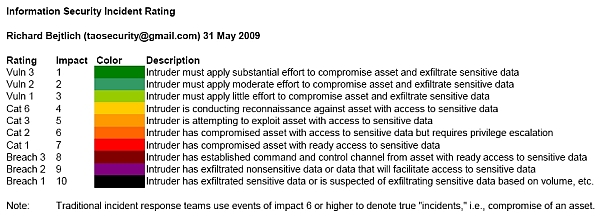
I've been trying to describe to management how close various individual information assets (primarily computers -- desktops, laptops, etc.) are to the doomsday scenario of sensitive data exfiltrated by unauthorized parties. This isn't the only type of incident that worries me, but it's the one I decided to tackle first. I view this situation as a continuum, rather than a "risk" rating. I'm trying summarize the state of affairs for an individual asset rather than "model risk."

In the far left column I've listed some terms that may be unfamiliar. The first three rows bear "Vuln" ratings. I list these because some of my businesses consider the discovery of a vulnerability in an asset to be an "incident" by itself. Traditional incident detectors and responders don't think this way, but I wanted to include this aspect of our problem set. For these first three rows, I consider these assets to exist without any discoverable or measurable adversary activity. In other words, assets of various levels of vulnerability are present, but no intruder is taking interest in them (as far as we can tell).

The next four rows (Cat 6, 3, 2, 1) should be familiar to those of you with military CIRT background. About 7 or 8 years ago I wrote this Category Descriptions document for Sguil. You'll remember Cat 6 as Reconnaissance, Cat 3 as Attempted Intrusion, Cat 2 as User Intrusion, and Cat 1 as Root/Admin Intrusion. I've mapped those "true incidents" here. These incidents indicate an intruder is taking interest in a system, to the degree that the intruder gains user or root level control of it. In the event the intruder doesn't need to gain control of the asset in order to steal data, you can simply jump to the appropriate description of the event in the final three rows.

The final three rows (Breach 3, 2, 1) are what you might consider "post exploitation" activities, or direct exploitation activities if no control of the asset is required in order to accomplish the adversary's data exfiltration mission. They loosely map to the reinforcement, consolidation, and pillage phases of compromise I outlined years ago. I've used the term "Breach" here to emphasize the seriousness of this aspect of an intrusion. (Gunter's recent post Botnet C&C Participation is a Corporate Data Breach reinforced my decision to use the term "breach" in situations like this.) Clearly Breach 3 is a severe problem. You might still be able to avoid catastrophe if you can contain the incident at this phase. However, intruders are likely to quickly move to Breach 2 and 1 phases, when it's Game Over.

If there has to be an "impact 0" rating, I would consider that to be the absence of an information asset, i.e., it doesn't exist. Any asset whatsoever has value, so I don't see a 0 value for any existing systems.

At the other end of the spectrum, if we have to "crank it to 11," I would consider an 11 to be publication of incident details in a widely-read public forum like a major newspaper or online news site.

I use the term "impact" in this sense: what is the negative impact of having the individual asset in the state described? In other words, the negative impact of having an asset with impact 1 is very low. We would all like to have assets that require an intruder to apply substantial effort to compromise the asset and exfiltrate sensitive data. At the other end of the spectrum we have the "game over" impact -- the intruder has exfiltrated sensitive data or is suspected of exfiltrating sensitive data based on volume, etc. Even if you can't tell exactly what an intruder exfiltrated, if you see several GBs of data leaving a system that houses or access sensitive data, you can be fairly confident the intruder grabbed it.

I listed some sample colors for those who understand the world in those terms.

I've reproduced the text below for future copying and pasting.

  1. Vuln 3 / Impact 1 / Intruder must apply substantial effort to compromise asset and exfiltrate sensitive data

  2. Vuln 2 / Impact 2 / Intruder must apply moderate effort to compromise asset and exfiltrate sensitive data

  3. Vuln 1 / Impact 3 / Intruder must apply little effort to compromise asset and exfiltrate sensitive data

  4. Cat 6 / Impact 4 / Intruder is conducting reconnaissance against asset with access to sensitive data

  5. Cat 3 / Impact 5 / Intruder is attempting to exploit asset with access to sensitive data

  6. Cat 2 / Impact 6 / Intruder has compromised asset with access to sensitive data but requires privilege escalation

  7. Cat 1 / Impact 7 / Intruder has compromised asset with ready access to sensitive data

  8. Breach 3 / Impact 8 / Intruder has established command and control channel from asset with ready access to sensitive data

  9. Breach 2 / Impact 9 / Intruder has exfiltrated nonsensitive data or data that will facilitate access to sensitive data

  10. Breach 1 / Impact 10 / Intruder has exfiltrated sensitive data or is suspected of exfiltrating sensitive data based on volume, etc.


What do you think of this rating system? I am curious to hear how others explain the seriousness of an incident to management.


Richard Bejtlich is teaching new classes in Las Vegas in 2009. Regular Las Vegas registration ends 1 July.

Minggu, 22 Maret 2009

NSM on Cisco AXP?

Last year I wrote Run Apps on Cisco ISR Routers. That was two weeks after our April Fool's joke that the Sguil Project Was Acquired by Cisco.

I am wondering if any TaoSecurity Blog readers are using Cisco AXP in production? Looking at the data sheet for the modules, they appear too underpowered for NSM applications, especially at the price point Cisco is advertising.


Richard Bejtlich is teaching new classes in Europe and Las Vegas in 2009. Online Europe registration ends by 1 Apr, and seats are filling. Early Las Vegas registration ends 1 May.

Selasa, 03 Februari 2009

Notes on Installing Sguil Using FreeBSD 7.1 Packages

It's been a while since I've looked at the Sguil ports for FreeBSD, so I decided to see how they work.

In this post I will talk about installing a Sguil sensor and server on a single FreeBSD 7.1 test VM using packages shipped with FreeBSD 7.1.

To start with the system had no packages installed.

After running pkg_add -vr sguil-sensor, I watched what was added to the system. I'm only going to document that which I found interesting.

The sguil-sensor-0.7.0_2 package installed the following into /usr/local.

x bin/sguil-sensor/log_packets.sh
x bin/sguil-sensor/example_agent.tcl
x bin/sguil-sensor/pcap_agent.tcl
x bin/sguil-sensor/snort_agent.tcl
x etc/sguil-sensor/example_agent.conf-sample
x etc/sguil-sensor/pcap_agent.conf-sample
x etc/sguil-sensor/snort_agent.conf-sample
x etc/sguil-sensor/log_packets.conf-sample
x share/doc/sguil-sensor <- multiple files, omitted here
x etc/rc.d/example_agent
x etc/rc.d/pcap_agent
x etc/rc.d/snort_agent

Note that you have to copy

pcap_agent.conf-sample
log_packets.conf-sample
snort_agent.conf-sample

to

pcap_agent.conf
log_packets.conf
snort_agent.conf

and edit each, prior to starting

pcap_agent.tcl
log_packets.sh
snort_agent.tcl

via

rc.d/pcap_agent
cron
rc.d/snort_agent

Also, as noted in the configuration options, PADS and SANCP are not installed by default, so the package doesn't include them:

===> The following configuration options are available for sguil-sensor-0.7.0_2:
SANCP=off (default) "Include sancp sensor"
PADS=off (default) "Include pads sensor"
===> Use 'make config' to modify these settings


The snort-2.8.2.1_1 package installed the following.

x man/man8/snort.8.gz
x bin/snort
x etc/snort/classification.config-sample
x etc/snort/gen-msg.map-sample
x etc/snort/reference.config-sample
x etc/snort/sid-msg.map-sample
x etc/snort/snort.conf-sample
x etc/snort/threshold.conf-sample
x etc/snort/unicode.map-sample
x src/snort_dynamicsrc/bitop.h
x src/snort_dynamicsrc/debug.h
x src/snort_dynamicsrc/pcap_pkthdr32.h
x src/snort_dynamicsrc/preprocids.h
x src/snort_dynamicsrc/profiler.h
x src/snort_dynamicsrc/sf_dynamic_common.h
x src/snort_dynamicsrc/sf_dynamic_meta.h
x src/snort_dynamicsrc/sf_dynamic_preproc_lib.c
x src/snort_dynamicsrc/sf_dynamic_preproc_lib.h
x src/snort_dynamicsrc/sf_dynamic_preprocessor.h
x src/snort_dynamicsrc/sf_snort_packet.h
x src/snort_dynamicsrc/sf_snort_plugin_api.h
x src/snort_dynamicsrc/sfghash.h
x src/snort_dynamicsrc/sfhashfcn.h
x src/snort_dynamicsrc/sfsnort_dynamic_detection_lib.c
x src/snort_dynamicsrc/sfsnort_dynamic_detection_lib.h
x src/snort_dynamicsrc/str_search.h
x src/snort_dynamicsrc/stream_api.h
x lib/snort/dynamicengine/libsf_engine.so
x lib/snort/dynamicengine/libsf_engine.so.0
x lib/snort/dynamicengine/libsf_engine.la
x lib/snort/dynamicengine/libsf_engine.a
x lib/snort/dynamicrules/lib_sfdynamic_example_rule.so
x lib/snort/dynamicrules/lib_sfdynamic_example_rule.so.0
x lib/snort/dynamicrules/lib_sfdynamic_example_rule.la
x lib/snort/dynamicrules/lib_sfdynamic_example_rule.a
x lib/snort/dynamicpreprocessor/lib_sfdynamic_preprocessor_example.a
x lib/snort/dynamicpreprocessor/lib_sfdynamic_preprocessor_example.la
x lib/snort/dynamicpreprocessor/lib_sfdynamic_preprocessor_example.so
x lib/snort/dynamicpreprocessor/lib_sfdynamic_preprocessor_example.so.0
x lib/snort/dynamicpreprocessor/libsf_dcerpc_preproc.a
x lib/snort/dynamicpreprocessor/libsf_dcerpc_preproc.la
x lib/snort/dynamicpreprocessor/libsf_dcerpc_preproc.so
x lib/snort/dynamicpreprocessor/libsf_dcerpc_preproc.so.0
x lib/snort/dynamicpreprocessor/libsf_dns_preproc.a
x lib/snort/dynamicpreprocessor/libsf_dns_preproc.la
x lib/snort/dynamicpreprocessor/libsf_dns_preproc.so
x lib/snort/dynamicpreprocessor/libsf_dns_preproc.so.0
x lib/snort/dynamicpreprocessor/libsf_ftptelnet_preproc.a
x lib/snort/dynamicpreprocessor/libsf_ftptelnet_preproc.la
x lib/snort/dynamicpreprocessor/libsf_ftptelnet_preproc.so
x lib/snort/dynamicpreprocessor/libsf_ftptelnet_preproc.so.0
x lib/snort/dynamicpreprocessor/libsf_smtp_preproc.a
x lib/snort/dynamicpreprocessor/libsf_smtp_preproc.la
x lib/snort/dynamicpreprocessor/libsf_smtp_preproc.so
x lib/snort/dynamicpreprocessor/libsf_smtp_preproc.so.0
x lib/snort/dynamicpreprocessor/libsf_ssh_preproc.a
x lib/snort/dynamicpreprocessor/libsf_ssh_preproc.la
x lib/snort/dynamicpreprocessor/libsf_ssh_preproc.so
x lib/snort/dynamicpreprocessor/libsf_ssh_preproc.so.0
x lib/snort/dynamicpreprocessor/libsf_ssl_preproc.a
x lib/snort/dynamicpreprocessor/libsf_ssl_preproc.la
x lib/snort/dynamicpreprocessor/libsf_ssl_preproc.so
x lib/snort/dynamicpreprocessor/libsf_ssl_preproc.so.0
x share/examples/snort/classification.config-sample <- copied to classification.config
x share/examples/snort/create_db2
x share/examples/snort/create_mssql
x share/examples/snort/create_mysql
x share/examples/snort/create_oracle.sql
x share/examples/snort/create_postgresql
x share/examples/snort/gen-msg.map-sample <- copied to gen-msg.map
x share/examples/snort/reference.config-sample <- copied to reference.config
x share/examples/snort/sid-msg.map-sample <- copied to sid-msg.map
x share/examples/snort/snort.conf-sample <- copied to snort.conf
x share/examples/snort/threshold.conf-sample <- copied to threshold.conf
x share/examples/snort/unicode.map-sample <- copied to unicode.map
x share/doc/snort <- multiple files, omitted here
x etc/rc.d/snort

These are the configuration options for Snort.

===> The following configuration options are available for snort-2.8.2.2_2:
DYNAMIC=on (default) "Enable dynamic plugin support"
FLEXRESP=off (default) "Flexible response to events"
FLEXRESP2=off (default) "Flexible response to events (version 2)"
MYSQL=off (default) "Enable MySQL support"
ODBC=off (default) "Enable ODBC support"
POSTGRESQL=off (default) "Enable PostgreSQL support"
PRELUDE=off (default) "Enable Prelude NIDS integration"
PERPROFILE=off (default) "Enable Performance Profiling"
SNORTSAM=off (default) "Enable output plugin to SnortSam"
===> Use 'make config' to modify these settings

I'm glad dynamic plugin support is enabled, but disappointed to see performance profiling disabled. The --enable-timestats option isn't available via the port at all, apparently.

The FreeBSD port/package can't ship with rules, so you need to download your own rules from Sourcefire, along with any Emerging Threats rules you might want to enable. You then need to edit the snort.conf file to account for your HOME_NET and rule preferences.

The barnyard-sguil-0.2.0_5 package installed the following.

x bin/barnyard
x etc/barnyard.conf-sample <- copied to etc/barnyard.conf by the port
x share/doc/barnyard <- multiple files, omitted here
x etc/rc.d/barnyard

I noticed the barnyard.conf only contained

output sguil

Usually we need something like this:

output sguil: sensor_name sensornamegoeshere

When done the following packages are installed:

tao# pkg_info
barnyard-sguil-0.2.0_5 An output system for Snort (patched for sguil)
mysql-client-5.0.67_1 Multithreaded SQL database (client)
pcre-7.7_1 Perl Compatible Regular Expressions library
sguil-sensor-0.7.0_2 Sguil is a network security monitoring program
snort-2.8.2.1_1 Lightweight network intrusion detection system
tcl-8.4.19,1 Tool Command Language
tclX-8.4_1 Extended TCL
tcltls-1.6 SSL extensions for TCL; dynamicly loadable

Because I want this test system to host the Sguil server too, I decided to move to that phase of the testing.

Before add the sguil-server package, I need to install MySQL server 5.0. This is due to the configuration options:

===> The following configuration options are available for sguil-server-0.7.0_2:
MYSQL50=off (default) "Install mysql50 server"
===> Use 'make config' to modify these settings

I assume this is the case because the port maintainer prefers running MySQL on one system and the Sguil server on another.

Therefore, I install MySQL server 5.0 using pkg_add -vr mysql50-server.

Next I stopped MySQL via /usr/local/etc/rc.d/mysql stop. This is critical for the next step in the process.

I installed sguil-server next via pkg_add -vr sguil-server.

The sguil-server-0.7.0_2 package installed the following.

x bin/archive_sguildb.tcl
x bin/incident_report.tcl
x bin/sguild
x etc/sguil-server/autocat.conf-sample
x etc/sguil-server/sguild.access-sample
x etc/sguil-server/sguild.conf-sample
x etc/sguil-server/sguild.email-sample
x etc/sguil-server/sguild.queries-sample
x etc/sguil-server/sguild.reports-sample
x etc/sguil-server/sguild.users-sample
x lib/sguil-server/SguildAccess.tcl
x lib/sguil-server/SguildAutoCat.tcl
x lib/sguil-server/SguildClientCmdRcvd.tcl
x lib/sguil-server/SguildConnect.tcl
x lib/sguil-server/SguildCreateDB.tcl
x lib/sguil-server/SguildEmailEvent.tcl
x lib/sguil-server/SguildEvent.tcl
x lib/sguil-server/SguildGenericDB.tcl
x lib/sguil-server/SguildGenericEvent.tcl
x lib/sguil-server/SguildHealthChecks.tcl
x lib/sguil-server/SguildLoaderd.tcl
x lib/sguil-server/SguildMysqlMerge.tcl
x lib/sguil-server/SguildPadsLib.tcl
x lib/sguil-server/SguildQueryd.tcl
x lib/sguil-server/SguildReportBuilder.tcl
x lib/sguil-server/SguildSendComms.tcl
x lib/sguil-server/SguildSensorAgentComms.tcl
x lib/sguil-server/SguildSensorCmdRcvd.tcl
x lib/sguil-server/SguildTranscript.tcl
x lib/sguil-server/SguildUtils.tcl
x share/sguil-server/create_ruledb.sql
x share/sguil-server/create_sguildb.sql
x share/sguil-server/migrate_event.tcl
x share/sguil-server/migrate_sancp.tcl
x share/sguil-server/sancp_cleanup.tcl
x share/sguil-server/update_0.7.tcl
x share/sguil-server/update_sguildb_v5-v6.sql
x share/sguil-server/update_sguildb_v6-v7.sql
x share/sguil-server/update_sguildb_v7-v8.sql
x share/sguil-server/update_sguildb_v8-v9.sql
x share/sguil-server/update_sguildb_v9-v10.sql
x share/sguil-server/update_sguildb_v10-v11.sql
x share/sguil-server/update_sguildb_v11-v12.sql
x share/doc/sguil-server/CHANGES
x share/doc/sguil-server/FAQ
x share/doc/sguil-server/INSTALL
x share/doc/sguil-server/INSTALL.openbsd
x share/doc/sguil-server/LICENSE.QPL
x share/doc/sguil-server/OPENSSL.README
x share/doc/sguil-server/TODO
x share/doc/sguil-server/UPGRADE
x share/doc/sguil-server/USAGE
x share/doc/sguil-server/sguildb.dia
x etc/rc.d/sguild

What came next was very interesting. The port maintainer created a script to help set up the server. I'll show relevant excerpts.

Running pre-install for sguil-server-0.7.0_2..
This sguild install script creates a "turnkey" install
of sguild, including configuing the database and conf files
and user accounts so that sguild can be started immediately.

You may have already done all this (especially if this is an upgrade)
and may not be interested in iterating through cert creation and
everything else that the script does.

This portion of the script creates user and group accounts named "sguil".
Would you like to opt out of this portion of the install script
n
==> Pre-installation configuration of sguil-server-0.7.0_2
User 'sguil' create successfully.
sguil:*:1002:1002::0:0:User &:/home/sguil:/usr/sbin/nologin
...edited...
Running post-install for sguil-server-0.7.0_2..
This sguild install script creates a "turnkey" install
of sguild, including configuing the database and conf files
and user accounts so that sguild can be started immediately.

You may have already done all this (especially if this is an upgrade)
and may not be interested in iterating through cert creation and
everything else that the script does.

Would you like to opt out of the entire install script
and configure sguild manually yourself?
n
There are a few things that need to be done to complete the install.
First, you need to create certs so that the ssl connections between server and
sensors will work, you need to create the database, the account to access it and
the tables for the database and you need to create the directories where all the
data will be stored. (You will also need to edit the conf files for your setup.)


If you haven't already done this, I can do it for you now.
Would you like to create certs now? (y for yes, n for no)
y
Creating /usr/local/etc/sguil-server/certs ....
First we need to create a password-protected CA cert.

(The Common Name should be the FQHN of your squil server.)
Generating a 1024 bit RSA private key
.....++++++
.......................................++++++
writing new private key to 'privkey.pem'
Enter PEM pass phrase:
Verifying - Enter PEM pass phrase:
-----
You are about to be asked to enter information that will be incorporated
into your certificate request.
What you are about to enter is what is called a Distinguished Name or a DN.
There are quite a few fields but you can leave some blank
For some fields there will be a default value,
If you enter '.', the field will be left blank.
-----
Country Name (2 letter code) [AU]:US
State or Province Name (full name) [Some-State]:VA
Locality Name (eg, city) []:M
Organization Name (eg, company) [Internet Widgits Pty Ltd]:T
Organizational Unit Name (eg, section) []:O
Common Name (eg, YOUR name) []:R
Email Address []:o

Please enter the following 'extra' attributes
to be sent with your certificate request
A challenge password []:sguil
An optional company name []:
Now we need to create the actual certificate for your server.
Signature ok
subject=/C=US/ST=VA/L=M/O=T/OU=O/CN=R/emailAddress=o
Getting CA Private Key
Enter pass phrase for privkey.pem:
Finally, we need to move the certs to the '/usr/local/etc/sguil-server/certs}' directory
and clean up the port directory as well.
mv: rename /a/ports/security/sguil-server/sguild.key to /usr/local/etc/sguil-server/certs/sguild.key:
No such file or directory
mv: rename /a/ports/security/sguil-server/sguild.pem to /usr/local/etc/sguil-server/certs/sguild.pem:
No such file or directory
rm: /a/ports/security/sguil-server/CA.pem: No such file or directory
rm: /a/ports/security/sguil-server/privkey.pem: No such file or directory
rm: /a/ports/security/sguil-server/sguild.req: No such file or directory
rm: /a/ports/security/sguil-server/file.sr1: No such file or directory

Those errors happen because the script was written with the assumption that it would be run from a ports installation, not a package installation. I emailed the ports maintainer to see if the problem can be fixed.

Is the installation of mysql brand new and unaltered?
By default, when mysql is installed, it creates five accounts.
None of those accounts are protected by passwords. That needs to be corrected.
The five accounts are:
root@localhost
root@127.0.0.1
root@tao.taosecurity.com
@localhost
@tao.taosecurity.com
I can remove all of the accounts except root@localhost (highly recommended)
and I can set the password for the root@localhost account. (If you get an error
don't worry about it. The account may not have been created to begin with.
Would you like me to do that now?
y
Enabling mysql in /etc/rc.conf and starting the server.....
It appears that mysql is already enabled!

The mysql pid is ....
Starting mysql.
Deleting users from mysql......
All done deleting.......
What would you like root@localhost's password to be?
root
Would you like to bind mysql to localhost so it only listens on that address?

y
The mysql pid is 1694.....
Stopping mysql.
Waiting for PIDS: 1694.
Starting mysql.
Would you like to create the database to store all nsm data?

y
NOTE: If you're upgrading, you do NOT want to do this! You want to upgrade.
./+INSTALL: cannot open /work/a/ports/security/sguil-server/work/sguil-0.7.0/server/sql_scripts/create_sguildb.sql:
No such file or directory

This error is similar to the previous error. I also emailed the port maintainer.

Would you like to create a user "sguild@localhost" for database access?

y
Please enter the password that you want to use for the sguild account.

sguil
Creating account for sguild with access to sguildb.....
Would you like to create the data directory and all its subdirectories?

y
What do you want the name of the main directory to be?
(Be sure to include the full path to the directory - e.g. /var/nsm)
/var/nsm
The main directory will be named '/var/nsm'.
Creating /var/nsm ....
Creating /var/nsm/archives ....
Creating /var/nsm/rules ....
Creating /var/nsm/load ....
Would you like to enable sguild in /etc/rc.conf?

y
iWriting to /etc/rc.conf....

If the sguild.conf file does not exist, I will create and edit it now.

Preparing to edit the sguild.conf file......
You still need to review all the conf files and configure sguil
per your desired setup before starting sguild. Refer to the port docs in
/usr/local/share/doc/sguil-server before proceeding.

Right now, all the conf files except sguild.conf are set to the defaults.
...edited...

That ends the need for user input. The final step advises the user on other required changes.

***********************************
* !!!!!!!!!!! WARNING !!!!!!!!!!! *
***********************************

PLEASE NOTE: If you are upgrading from a previous version,
read the UPGRADE doc (in /usr/local/share/doc/sguil-server) before proceeding!!!
Some noteworthy changes in version 0.7.0:
SSL is now required for server, sensor and client.
The sguild.conf and sguild.email files have changed.
You MUST run the upgrade_0.7.tcl script to clean up and
prepare the database before running the new version. BE SURE
TO BACK UP YOUR DATABASE BEFORE PROCEEDING!!!

If you had existing config files in /usr/local/etc/sguil-server
they were not overwritten. If this is a first time install, you
must copy the sample files to the corresponding conf file and
edit the various config files for your site. See the INSTALL
doc in /usr/local/share/doc/sguil-server for details. If this is an upgrade, replace
your existing conf file with the new one and edit accordingly.

The sql scripts for creating database tables were placed in
the /usr/local/share/sguil-server/ directory. PLEASE
NOTE: LOG_DIR is not set by this install. You MUST create the
correct LOG_DIRS and put a copy of the snort rules you use in
LOG_DIR/rules.

The sguild, archive_sguildb.tcl and incident_report.tcl scripts
were placed in /usr/local/bin/. The incident_report.tcl
script is from the contrib section. There is no documentation
and the script's variables must be edited before it is used.

A startup script, named sguild.sh was installed in
/usr/local/etc/rc.d/. To enable it, edit /etc/rc.conf
per the instructions in the script.

NOTE: Sguild now runs under the sguil user account not root!

At the end of the process the system had these packages installed.

tao# pkg_info
barnyard-sguil-0.2.0_5 An output system for Snort (patched for sguil)
mysql-client-5.0.67_1 Multithreaded SQL database (client)
mysql-server-5.0.67_1 Multithreaded SQL database (server)
mysqltcl-3.05 TCL module for accessing MySQL databases based on msqltcl
p0f-2.0.8 Passive OS fingerprinting tool
pcre-7.7_1 Perl Compatible Regular Expressions library
sguil-sensor-0.7.0_2 Sguil is a network security monitoring program
sguil-server-0.7.0_2 Sguil is a network security monitoring program
snort-2.8.2.1_1 Lightweight network intrusion detection system
tcl-8.4.19,1 Tool Command Language
tclX-8.4_1 Extended TCL
tcllib-1.10_1 A collection of utility modules for Tcl
tcltls-1.6 SSL extensions for TCL; dynamicly loadable
tcpflow-0.21_1 A tool for capturing data transmitted as part of TCP connec

If I wanted to go from here to actually run the Sguil server, I would have to manually create the database and certificates. Once the script is fixed I shouldn't have to do that.

The major configuration issue that remains is ensuring that data is being written to logical locations. This primarily means pcap data is stored in a partition that can accommodate it, and the database is located in a partition that can handle growing tables.

I think it should be clear at this point that the easiest way to try Sguil is to use NSMNow. I recommend that only for demo installations, although you can tweak the installation to put what you want in locations you like.


Richard Bejtlich is teaching new classes in DC and Europe in 2009. Register by 1 Jan and 1 Feb, respectively, for the best rates.

Senin, 29 Desember 2008

Installing Sguil Using NSMNow


In my post NSM-Friendly VMware Lab Setup I mentioned wanting to use NSMNow to install Sguil on Ubuntu 8.04 for student use in my next class. I had tried the Securix-NSM live CD but I had not tried installing Sguil using the same project's NSMNow scripts. I just did it:


root@twsu804:/usr/local/src# wget http://www.securixlive.com/download/nsmnow/NSMnow-1.1.1.tar.gz
--22:14:38-- http://www.securixlive.com/download/nsmnow/NSMnow-1.1.1.tar.gz
=> `NSMnow-1.1.1.tar.gz'
Resolving www.securixlive.com... 202.191.61.156
Connecting to www.securixlive.com|202.191.61.156|:80... connected.
HTTP request sent, awaiting response... 200 OK
Length: 164,613 (161K) [application/x-gzip]

100%[====================================>] 164,613 53.85K/s

22:14:42 (53.80 KB/s) - `NSMnow-1.1.1.tar.gz' saved [164613/164613]

root@twsu804:/usr/local/src# tar -xzvf NSMnow-1.1.1.tar.gz
NSMnow-1.1.1/
NSMnow-1.1.1/NSMnow-core
NSMnow-1.1.1/RELEASE.NOTES
NSMnow-1.1.1/templates/
NSMnow-1.1.1/templates/lib/
NSMnow-1.1.1/templates/lib/lib-console-utils
NSMnow-1.1.1/templates/init/
NSMnow-1.1.1/templates/init/sancpd
NSMnow-1.1.1/templates/init/snortl-newday
NSMnow-1.1.1/templates/init/snortu
NSMnow-1.1.1/templates/init/pcap_agent
NSMnow-1.1.1/templates/init/barnyard2
NSMnow-1.1.1/templates/init/sguild
NSMnow-1.1.1/templates/init/snort_agent
NSMnow-1.1.1/templates/init/snortl
NSMnow-1.1.1/templates/init/sancp_agent
NSMnow-1.1.1/templates/rules/
NSMnow-1.1.1/templates/rules/pop3.rules
NSMnow-1.1.1/templates/rules/finger.rules
NSMnow-1.1.1/templates/rules/dos.rules
NSMnow-1.1.1/templates/rules/shellcode.rules
NSMnow-1.1.1/templates/rules/dns.rules
NSMnow-1.1.1/templates/rules/attack-responses.rules
NSMnow-1.1.1/templates/rules/local.rules
NSMnow-1.1.1/templates/rules/icmp-info.rules
NSMnow-1.1.1/templates/rules/policy.rules
NSMnow-1.1.1/templates/rules/web-cgi.rules
NSMnow-1.1.1/templates/rules/ddos.rules
NSMnow-1.1.1/templates/rules/mysql.rules
NSMnow-1.1.1/templates/rules/oracle.rules
NSMnow-1.1.1/templates/rules/other-ids.rules
NSMnow-1.1.1/templates/rules/icmp.rules
NSMnow-1.1.1/templates/rules/experimental.rules
NSMnow-1.1.1/templates/rules/chat.rules
NSMnow-1.1.1/templates/rules/info.rules
NSMnow-1.1.1/templates/rules/web-attacks.rules
NSMnow-1.1.1/templates/rules/nntp.rules
NSMnow-1.1.1/templates/rules/telnet.rules
NSMnow-1.1.1/templates/rules/scan.rules
NSMnow-1.1.1/templates/rules/rservices.rules
NSMnow-1.1.1/templates/rules/web-php.rules
NSMnow-1.1.1/templates/rules/bad-traffic.rules
NSMnow-1.1.1/templates/rules/snmp.rules
NSMnow-1.1.1/templates/rules/web-coldfusion.rules
NSMnow-1.1.1/templates/rules/tftp.rules
NSMnow-1.1.1/templates/rules/ftp.rules
NSMnow-1.1.1/templates/rules/misc.rules
NSMnow-1.1.1/templates/rules/multimedia.rules
NSMnow-1.1.1/templates/rules/web-frontpage.rules
NSMnow-1.1.1/templates/rules/imap.rules
NSMnow-1.1.1/templates/rules/porn.rules
NSMnow-1.1.1/templates/rules/web-client.rules
NSMnow-1.1.1/templates/rules/netbios.rules
NSMnow-1.1.1/templates/rules/p2p.rules
NSMnow-1.1.1/templates/rules/rpc.rules
NSMnow-1.1.1/templates/rules/web-misc.rules
NSMnow-1.1.1/templates/rules/backdoor.rules
NSMnow-1.1.1/templates/rules/pop2.rules
NSMnow-1.1.1/templates/rules/exploit.rules
NSMnow-1.1.1/templates/rules/sql.rules
NSMnow-1.1.1/templates/rules/virus.rules
NSMnow-1.1.1/templates/rules/x11.rules
NSMnow-1.1.1/templates/rules/smtp.rules
NSMnow-1.1.1/templates/rules/deleted.rules
NSMnow-1.1.1/templates/rules/web-iis.rules
NSMnow-1.1.1/LICENCE
NSMnow-1.1.1/NSMnow.conf
NSMnow-1.1.1/libs/
NSMnow-1.1.1/libs/barnyard2.pm
NSMnow-1.1.1/libs/utils.pm
NSMnow-1.1.1/libs/sguilsensor.pm
NSMnow-1.1.1/libs/sguilclient.pm
NSMnow-1.1.1/libs/utils.sh
NSMnow-1.1.1/libs/mysql.pm
NSMnow-1.1.1/libs/sguiltools.pm
NSMnow-1.1.1/libs/tcl.pm
NSMnow-1.1.1/libs/os.pm
NSMnow-1.1.1/libs/buildessential.pm
NSMnow-1.1.1/libs/sguilserver.pm
NSMnow-1.1.1/libs/os.sh
NSMnow-1.1.1/libs/snort.pm
NSMnow-1.1.1/libs/sancp.pm
NSMnow-1.1.1/README
NSMnow-1.1.1/INSTALL
NSMnow-1.1.1/NSMnow.log
NSMnow-1.1.1/run-init
NSMnow-1.1.1/NSMnow
NSMnow-1.1.1/README.apparmor
NSMnow-1.1.1/MANUAL

root@twsu804:/usr/local/src# cd NSMnow-1.1.1/

root@twsu804:/usr/local/src/NSMnow-1.1.1# ls
INSTALL MANUAL NSMnow-core README.apparmor templates
libs NSMnow NSMnow.log RELEASE.NOTES
LICENCE NSMnow.conf README run-init

root@twsu804:/usr/local/src/NSMnow-1.1.1# ./NSMnow -i

Allow pre-checks to install requisite packages [Y]:
[2008/12/29 22:18:05] #1 - Performing NSMnow pre-checks.
[2008/12/29 22:21:06] #1 - Pre-checks completed successully
[2008/12/29 22:21:06] #1 - Detected platform: UBUNTU
[2008/12/29 22:21:06] #1 - Action: Installing package(s).

Download Directory
Path where all downloaded files will be saved to
[./source]:

Source Directory
Path where all source tarballs will be extracted to
[./source]:

Sensor Name
A unique name given to deliniate sensors from one another
[sensor1]: twsu804a

Sensor Interface
Enter the interface that this sesnor will be monitoring
[eth0]: eth1

Configuration Path
Path to where all sensor related configuration files will be stored
[/etc/nsm]:

Sensor Data Path
Path to where all sensor captured information will be stored
[/nsm/sensor_data]:

Server Host
Hostname or IP of the server component that this sensor will connect to
[localhost]:

Server Name
A unique name given to deliniate servers from one another
[server1]:

Server Data Path
Path to where all server collected information will be stored
[/nsm/server_data]:

Server Database Name
Name of the sguil database which will store all sguil correlated information.
[sguildb]:

Server Database User
Name of the user who will have access rights to the sguil database.
[sguil]:

Server Database Password
Password of the user who will have access rights to the sguil database.
[password]: sguil

Client User
Name of the sguil client user who will have access the sguil server.
[sguil]:

Client Password
Password of the sguil client user who will have access to the sguil server.
[password]: sguil

Server Host
Hostname or IP of the server component that this client will connect to
[localhost]:
[2008/12/29 22:23:16] #1 - Installing package: mysql
[2008/12/29 22:23:16] #1 - Installing with: apt-get -y install mysql-server
[2008/12/29 22:28:22] #1 - Installing package: tcl
[2008/12/29 22:28:22] #1 - Installing with: apt-get -y install tcl8.3
itcl3 mysqltcl tcltls tcllib tcl8.3-dev iwidgets4 tclx8.4 itk3 tcl8.4 tk8.4
[2008/12/29 22:29:23] #1 - Installing package: buildessential
[2008/12/29 22:29:23] #1 - Installing with: apt-get -y install libpcre3-dev
libpcap0.8-dev build-essential
[2008/12/29 22:29:43] #1 - Installing package: snort
Download snort tarball? [Y]: y
[2008/12/29 22:39:37] #1 - Configuring with: ./configure --enable-perfprofiling
[2008/12/29 22:40:29] #1 - Compiling with: make
[2008/12/29 22:43:50] #1 - Installing with: make install
[2008/12/29 22:44:02] #1 - Installing package: barnyard2
Download barnyard2 tarball? [Y]: y
[2008/12/29 22:44:29] #1 - Configuring with: ./configure --with-tcl=/usr/lib/tcl8.3
[2008/12/29 22:44:54] #1 - Compiling with: make
[2008/12/29 22:45:10] #1 - Installing with: make install
[2008/12/29 22:45:10] #1 - Installing package: sancp
Download sancp tarball? [Y]: y
[2008/12/29 22:45:18] #1 - Compiling with: make linux
[2008/12/29 22:45:37] #1 - Installing with: cp sancp /usr/local/bin
[2008/12/29 22:45:37] #1 - Installing package: sguilsensor
Download sguil-sensor (sguil) package(s)? [Y]: y
[2008/12/29 22:46:09] #1 - Installing sguil-sensor binaries
[2008/12/29 22:46:10] #1 - Installing package: sguilclient
[2008/12/29 22:46:10] #1 - Installing sguil-client library files
[2008/12/29 22:46:10] #1 - Installing sguil-client binary
[2008/12/29 22:46:10] #1 - Installing package: sguilserver
[2008/12/29 22:46:10] #1 - Installing sguil-server library files
[2008/12/29 22:46:10] #1 - Installing sguil-server binary
[2008/12/29 22:46:10] #1 - Installing package: sguiltools
[2008/12/29 22:46:10] #1 - Installing with: apt-get -y install wireshark p0f tcpflow tcpdump
[2008/12/29 22:47:24] #1 - Configuring package: mysql
* Stopping MySQL database server mysqld [ OK ]
Reloading AppArmor profiles : done.
* Starting MySQL database server mysqld [ OK ]
* Checking for corrupt, not cleanly closed and upgrade needing tables.
[2008/12/29 22:48:07] #1 - Configuring package: tcl
[2008/12/29 22:48:10] #1 - Configuring package: buildessential
[2008/12/29 22:48:10] #1 - Configuring package: snort
[2008/12/29 22:48:10] #1 - Generating snort config file: /etc/nsm/twsu804a/snort.conf
[2008/12/29 22:48:11] #1 - Configuring package: barnyard2
[2008/12/29 22:48:11] #1 - Generating barnyard2 config file: /etc/nsm/twsu804a/barnyard2.conf
[2008/12/29 22:48:12] #1 - Configuring package: sancp
[2008/12/29 22:48:12] #1 - Generating sancp config file: /etc/nsm/twsu804a/sancp.conf
[2008/12/29 22:48:12] #1 - Configuring package: sguilsensor
[2008/12/29 22:48:12] #1 - Generating sensor agent config file(s)
[2008/12/29 22:48:12] #1 - Configuring package: sguilclient
[2008/12/29 22:48:12] #1 - Generating sguil-client config file: /etc/sguil/sguil.conf
[2008/12/29 22:48:12] #1 - Configuring package: sguilserver
[2008/12/29 22:48:12] #1 - Configuring AppArmor profile
[2008/12/29 22:48:12] #1 - Ensure you restart AppArmor to apply changes
[2008/12/29 22:48:12] #1 - Generating sguil-server config file: /etc/sguild/sguild.conf
[2008/12/29 22:48:13] #1 - Updating sguild init file: /etc/init.d/sguild
Copy default rules file(s)? [Y]: y
What Sensor name is to be associated with these rules [sensor1]: twsu804a
[2008/12/29 22:49:20] #1 - Creating the CA certificate
[2008/12/29 22:49:22] #1 - Creating certificate request for: server1
[2008/12/29 22:49:22] #1 - Signing server certificate for: server1
[2008/12/29 22:49:22] #1 - Adding client user "sguil" to sguil server ACL.
[2008/12/29 22:49:22] #1 - Creating database and initial user.

You will need the mysql root password.
Enter password:
[2008/12/29 22:49:29] #1 - Configuring package: sguiltools
[2008/12/29 22:49:29] #1 - Completed installing package(s) successfully.

NOTE: Snort can log in either UTC or the localtime, so firstly make sure that all machines
are synced together.Secondly, either set the timezone on all machines to UTC or set the
timezone on all machines to the same andremove the $UTC variable from the OPTIONS variable
in both /etc/init.d/snortu and /etc/init.d/snortl

I decided to comment out the $UTC variable in the two scripts. Then I started the programs.

root@twsu804:/usr/local/src/NSMnow-1.1.1# ./run-init start
Starting - sguil server (sguild) [ OK ]
Starting - sguil: sensor snort_agent (snort_agent) [ OK ]
Starting - sguil: sensor pcap_agent (pcap_agent) [ OK ]
Starting - sguil: sensor sancp_agent (sancp_agent) [ OK ]
Starting - snort: IDS mode, unified output (snort_unified) [ OK ]
* output in /nsm/sensor_data/twsu804a, /ssn_logs, /portscans
Starting - barnyard2 (barnyard2) [ OK ]
* created directory: /var/log/barnyard2
* created directory: /var/log/barnyard2/twsu804a
Starting - sancp: session logging (sancpd) [ OK ]
* output in /nsm/sensor_data/twsu804a/sancp
Starting - snort: logging mode (snort_packetlogging) [ OK ]
* output in /nsm/sensor_data/twsu804a/dailylogs/2008-12-30
* created directory: /nsm/sensor_data/twsu804a/dailylogs
* created directory: /nsm/sensor_data/twsu804a/dailylogs/2008-12-30
* disk space currently at 43%
root@twsu804:/usr/local/src/NSMnow-1.1.1#

At this point I could start a user terminal, type sguil.tk, and start using the Sguil console. The only real change I made was to alter the default fonts. I would probably consolidate the three panels into 1 as well.

Very impressive! Great work guys.


Richard Bejtlich is teaching new classes in DC and Europe in 2009. Register by 1 Jan and 1 Feb, respectively, for the best rates.